
As demand for high-speed internet, IPTV, and cloud-based services continues to grow, fiber-optic networks have become the foundation of modern connectivity. At the heart of these networks lies the Optical Line Terminal (OLT)—a critical device that enables service providers to deliver data efficiently over fiber infrastructure. Without an OLT, large-scale fiber access networks such as FTTH (Fiber to the Home) would not function.
This blog explains what an OLT is, how it works, and why it plays such a vital role in fiber networks.
What Is an OLT?
An OLT is a central network device installed at the service provider’s central office or data center. Its primary role is to manage, control, and distribute data from the core network to multiple end users over a passive optical network (PON).
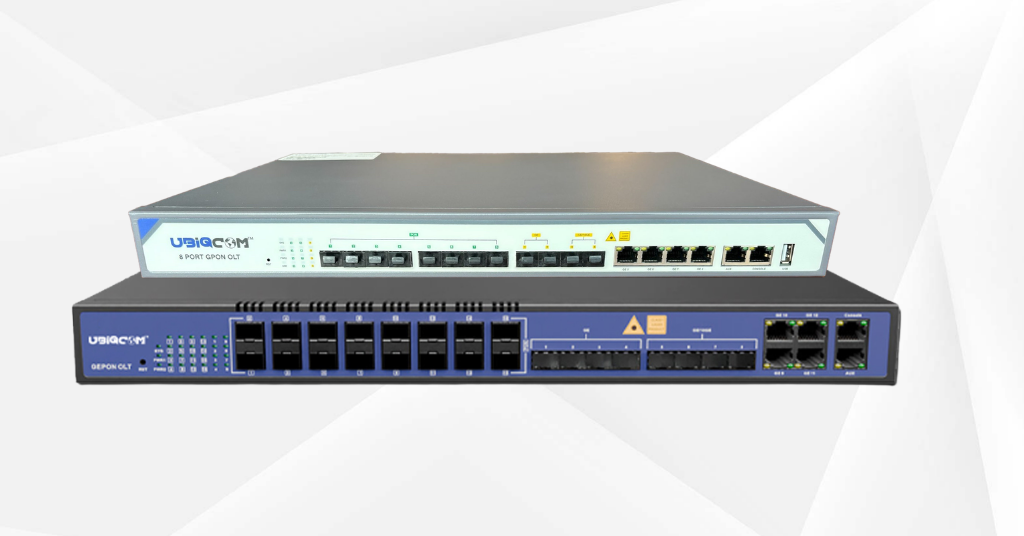
Instead of running individual fiber lines to every subscriber, the OLT sends data through a single fiber that is later split passively to serve many users. This design reduces infrastructure cost while maintaining high performance and reliability.
How an OLT Works in a Fiber Network
The operation of an OLT is based on point-to-multipoint communication. Data flows downstream from the OLT to multiple optical network units (ONUs or ONTs), while upstream traffic from users is carefully scheduled to avoid collisions.
Key functional aspects include:
- Downstream broadcast transmission to all connected subscribers
- Upstream traffic control using time-division mechanisms
- Bandwidth allocation based on user demand and service type
- Authentication and management of connected ONUs
This intelligent coordination allows a single OLT port to serve dozens or even hundreds of users efficiently.
Why OLT Is Important in Fiber Networks
The importance of an OLT goes far beyond simple data transmission. It acts as the control center of the entire access network.
First, it enables scalability. As subscriber demand increases, service providers can add more ONUs or expand capacity without redesigning the entire network. Second, it ensures quality of service by prioritizing critical applications such as voice and video over standard data traffic.
Most importantly, the OLT makes fiber networks cost-effective. By sharing fiber infrastructure among many users, providers can deliver gigabit-speed services while keeping deployment and operational costs under control.
Role of OLT in FTTH Deployments
In FTTH networks, the OLT is responsible for delivering triple-play services—internet, voice, and television—over a single fiber. It manages subscriber provisioning, service profiles, and performance monitoring from a centralized location.
Because FTTH networks rely heavily on long-term stability, the OLT must support high reliability, redundancy options, and remote management capabilities. This ensures uninterrupted service even as network scale and complexity grow.
OLT and Network Management
Modern OLTs are designed with advanced network management features. These include real-time monitoring, fault detection, and remote configuration. Service providers can quickly identify performance issues, manage bandwidth usage, and deploy new services without physical intervention.
Such capabilities are essential for maintaining service-level agreements and delivering a consistent user experience across large subscriber bases.
Conclusion
An OLT is the cornerstone of any fiber access network, acting as the bridge between the core network and end users. Its ability to efficiently distribute bandwidth, manage subscribers, and support scalable growth makes it indispensable in today’s high-speed connectivity landscape.